


Goffee & Jones argue that effective leadership is situational, relational and intensely personal. Great leaders succeed not because they imitate others, but because they understand what is unique about them and how to use those differences with skill.
1. Leadership Begins With You: Knowing and Showing Yourself
The book argues strongly that there are no universal leadership characteristics. What works brilliantly for one leader may fail completely for another. Effective leadership is grounded in three axioms:
- It is situational – dependent on context.
- It is non‑hierarchical – leadership can come from anywhere.
- It is relational – built through interaction, not just authority.
Central to their thesis is authenticity, defined as consistency between words and actions, comfort with self, and coherence in different roles.
But authenticity is not a licence to simply “be yourself.” Rather, it’s to be:
“Yourself – more – with skill.”
Authentic leaders understand their difference: the distinctive qualities or perspectives that make others want to follow them. They don’t copy Branson, Jobs, or any other archetype. They know what is special about them, and use it intentionally, not performatively.
This requires both:
- Knowing yourself – your values, purpose, strengths, and real weaknesses.
- Showing yourself – but appropriately and skilfully, so colleagues can actually understand you.
People cannot follow what they cannot see.
2. The Balance of Self‑Knowledge and Self‑Disclosure
Many leaders fail in one of two ways:
- They know themselves but don’t communicate it, leaving colleagues baffled or making incorrect assumptions.
- They disclose plenty but lack true self‑awareness, appearing phony or inconsistent.
Goffee & Jones argue that the differences that form your leadership identity must be:
- genuinely yours
- capable of creating excitement or appeal
- meaningful in your context
- aligned with your values and vision
Leaders must be courageous enough to show who they are, but not everything about who they are. Effective leadership is selective, thoughtful self‑revelation.
3. The Power of Tough Empathy and Showing Real Weaknesses
Caring – really caring – about the work and the people is fundamental. But caring is not indulgence. The authors call this tough empathy: giving people what they need, not necessarily what they want.
Showing vulnerability is a key part of this. Leaders should reveal selective weaknesses, the ones that:
- empower followers (“I can help with that.”)
- humanize the leader
- provide space for others to contribute
- clarify that the leader does not have every answer
These must be real, not contrived. And they must be revealed sparingly so weaknesses don’t overshadow strengths.
Above all, leaders must be anchored in purpose and values. Without that, neither toughness nor empathy can land well.
4. Situation Sensing: The ‘Authentic Chameleon’
Leadership is always contextual, and effective leaders read that context carefully. They act as authentic chameleons, able to adapt behaviour to circumstances without losing their sense of self.
Situation-sensing involves three capabilities:
- Perceiving what is going on
Leaders gather soft data: feelings, patterns, informal signals. Higher up the hierarchy, information becomes sanitised and less reliable; leaders must take deliberate steps to stay connected. - Interpreting and understanding it
Leaders stay curious about individuals: their motivations, histories, strengths, and anxieties. They take the time to understand groups, not just individuals, recognising team dynamics and development cycles (forming, storming, norming, performing). - Acting and adapting
Leaders flex between closeness and distance, pace and patience, strength and vulnerability. They use their behaviour to shape culture, not merely react to it.
The leader’s real contribution is not simply navigating context, but helping change it. They co-create with followers an alternative, more effective reality.
5. Conform Enough: The Paradox of Authenticity and Fitting In
Authenticity is vital, but unbounded authenticity can be fatal. Leaders who refuse to fit into their organisation’s social architecture rarely last long. The challenge is to conform enough to gain acceptance, while maintaining enough difference to create change.
Leaders must understand their organisation through two cultural lenses:
- Sociability – the warmth, friendliness, and personal bonds that shape daily interactions
- Solidarity – shared commitment to tasks, standards, and goals
Effective leaders work out how their personal style fits within that mix—and where it needs to challenge it.
They warn against two early-career traps:
- Freeze – being so in awe of the role that you lose the qualities that made you successful
- Please – adopting the values of the existing leadership too readily and losing your identity
Authentic leaders challenge and conform. They practise principles and compromise. They stay human and maintain role distance. Leadership is inherently paradoxical and requires comfort with contradiction.
6. The Dance of Closeness and Distance
One of the book’s most powerful chapters describes leadership as a dance between closeness and distance.
Closeness allows leaders to:
- understand what motivates people
- build trust
- communicate authenticity
- reveal appropriate weaknesses
- create warmth and community
Distance enables leaders to:
- maintain authority
- signal the overarching purpose
- make hard decisions
- shape the broader picture
- retain an aura of mystique or “edge”
Too much closeness leads to over‑familiarity, lost authority, and emotional entanglement.
Too much distance leads to fear, disengagement, and isolation.
Great leaders master the rhythm, moving closer or stepping back depending on what the situation and purpose demand.
7. Communication: Crafting Narrative, Pace and Motivation
Communication is not about transmitting information. It is about shaping meaning.
Effective leaders:
Use the right mode
They tailor communication to context and their own strengths, whether that’s big-stage speeches or informal soapbox conversations.
Create compelling narrative
Data alone does not motivate. Stories, analogies and examples create emotional engagement. Leaders use narrative to compare the present with a better future.
Get the pace right
Push too fast and followers freeze. Too slow and they disengage. The art is sensing the organisational tempo.
Balance pressure and vision
- Pressure for change creates urgency.
- Vision creates hope and direction.
Followers need both.
Signal capability challenges
Leaders recognise that people, not just strategy or resources, drive success. They invest in learners, celebrate solid contributors, and avoid focusing solely on “stars.”
Connect daily actions to the overall purpose
People need to understand how today’s task relates to tomorrow’s goal. A leader is always explaining the “why” behind the “what.”
Reward change
Followers take risks when they follow. Leaders must recognise this—often in personal ways that matter to the individual.
8. Why Follow You? What Followers Really Want
Leadership is only leadership if people choose to follow. The authors identify four universal follower needs:
1. Authenticity
They want to know who you really are: your values, your story, your quirks, your strengths and weaknesses, and to believe that what they see is real.
2. Significance
People need to feel seen, valued and important. Recognition – positive or honest developmental feedback – creates energy and commitment.
3. Excitement
Followers want leaders who energise them, who show passion, and who elevate their sense of possibility.
4. Community
People want to belong. Leaders build connection between individuals and connect everyone to a shared purpose bigger than themselves.
Importantly, the book ends by reminding us that followers can “lead leaders astray”—with flattery, group think, or collective technical logic that blinds leaders to wider risks. Ultimately:
Followers decide who the leaders really are.
In Summary
Goffee & Jones’s model dismantles the myth that leadership is a set of innate traits or prescribed behaviours. Instead, great leadership is a craft: the artful, situational use of your distinct personal qualities to inspire others toward shared purpose.
To lead effectively, you must:
- understand what is unique about you
- reveal it thoughtfully
- care fiercely and empathetically
- sense your context
- conform just enough
- balance closeness and distance
- communicate with narrative and purpose
- build authentic followership
In short:
Leadership is less about being perfect, and more about being human—with skill.
Find out more!
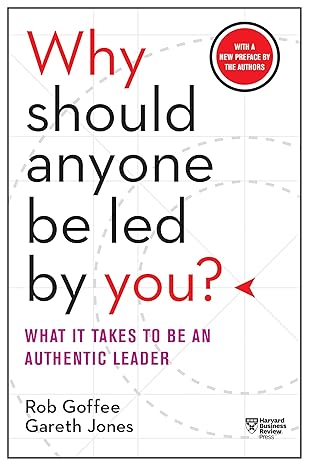
If you’re thinking about reading the book in full… just do it!
It is packed full of useful advice, but is very easy to read. There are useful diagnostic tools, too.
There is a follow-up book, which I am reading at the moment, Why Should Anyone Work Here?
