
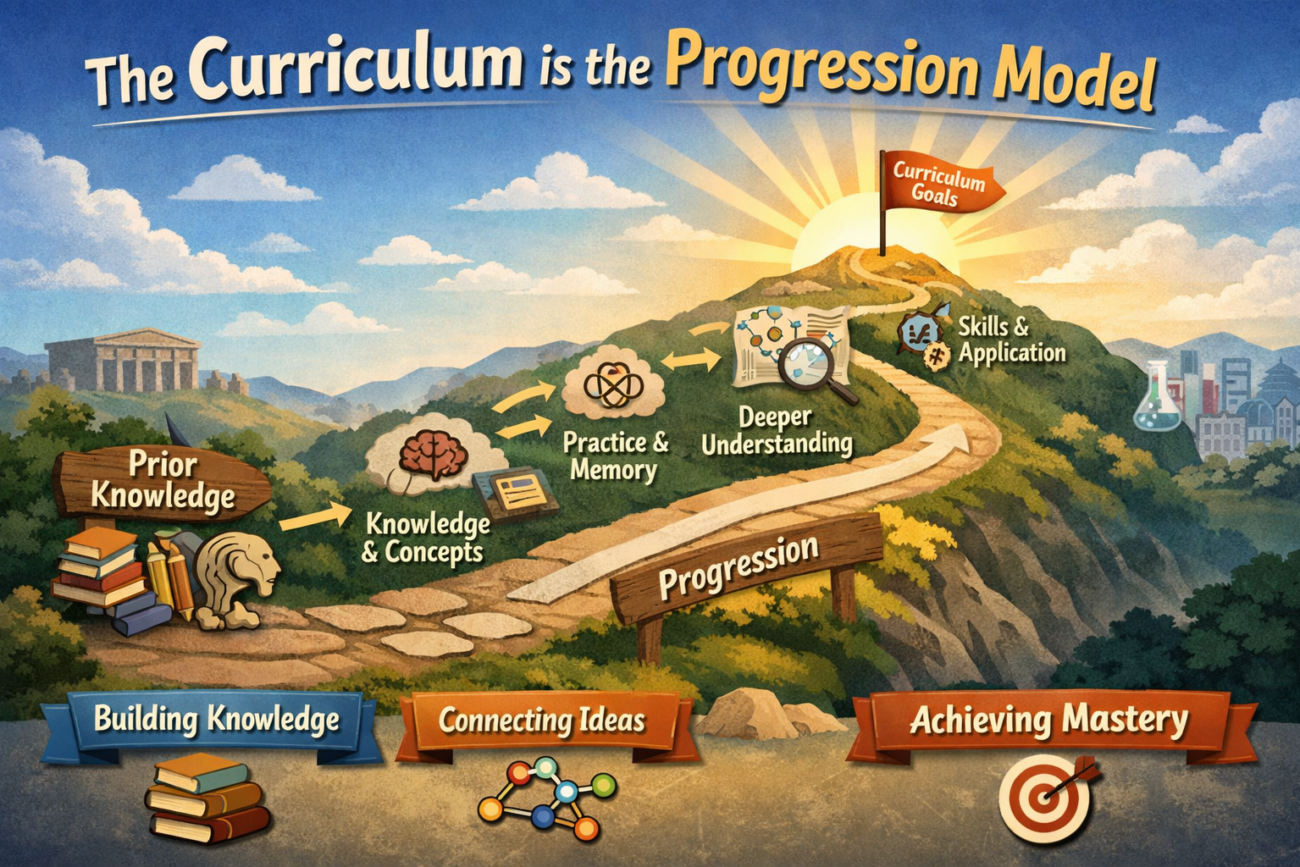
Christine Counsell and Michael Fordham argue that ‘the curriculum is the progression model’. In brief, they contend that domain-specific knowledge is the key to progression rather than generic skills. Here are ten top tips to help you embed this idea in your planning and practise.
1. Because progression means learning the actual curriculum, not a diluted version…
- Identify the precise knowledge (concepts, vocabulary, substantive content) pupils must secure in this lesson.
- Strip out tasks or activities that don’t directly serve that knowledge.
- Check that explanations, examples, and modelling all align with the curriculum step.
2. Because new knowledge rests on old knowledge, curriculum coherence is the engine of progression…
- Begin lessons with retrieval that revisits the specific prior knowledge this new step depends on.
- Make the link explicit: “You learned X so that you can now understand Y.”
- Keep a visible record of “knowledge we’re building on” in the room.
3. Because progression is domain‑specific, not generic, pupils progress by knowing more of the subject’s content…
- Frame success criteria in subject‑specific terms (“Explain how…”, “Use the concept of…”, “Apply the method of…”).
- Avoid generic verbs like “analyse” or “evaluate” without anchoring them in the content.
- Model what good thinking in this subject looks like.
4. Because pupils need the subject’s conceptual architecture to make sense of new material…
- Teach and revisit the organising concepts that structure the domain.
- Use concept maps, timelines, or schema to show how new knowledge fits into the bigger picture.
- Refer back to these structures whenever introducing new content.
5. Because remembering is not revision, it is progression…
- Build in spaced retrieval and cumulative quizzing as routine, not as test prep.
- Revisit earlier curriculum content even when it’s not part of the current unit.
- Use quick oral checks to keep foundational knowledge alive.
6. Because tasks must serve the curriculum, not the other way around…
- Choose tasks that require pupils to use the new knowledge in a way that exposes understanding.
- Avoid tasks where pupils can succeed through guesswork, copying, or scaffolding.
- Ask: “Does this task reveal whether pupils have learned the curriculum step?”
7. Because assessment should sample the domain, not mimic the exam…
- Use short, precise checks of key knowledge rather than relying solely on extended tasks.
- Design hinge questions that reveal whether pupils have grasped the core idea.
- Use assessment to illuminate gaps in the curriculum sequence, not just performance.
8. Because misconceptions show where pupils are in the curriculum journey…
- Anticipate likely misconceptions for each curriculum step.
- Use quick probes or hinge questions to surface them.
- Treat misconceptions as diagnostic information, not as errors to sweep away.
9. Because pupils benefit from seeing the curriculum as a coherent narrative…
- Display the curriculum map and refer to it regularly.
- Use narrative language: “Earlier you learned…”, “This prepares you for…”, “Later this will help you to…”.
- Help pupils see how each step fits into the wider story of the subject.
10. Because curriculum is a collective, disciplinary endeavour, no teacher holds the whole domain alone…
- Discuss with colleagues the knowledge that matters most at each step.
- Share explanations, models, misconceptions, and examples of pupil thinking.
- Align on why content is sequenced as it is and what each step enables.
You can read more about the curriculum as progression model in these two blogs by Michael Fordham and Joshua Vallance.
