
1. Cross‑curricularity has a long, troubled history… and often goes wrong
Counsell opens by noting that attempts to connect subjects “have been in and out of fashion… and often gone wrong” .
Poorly designed cross‑curricular projects collapse subject boundaries, dilute rigour, and create superficial links.
2. Subjects are coherent, disciplined ways of knowing. Not arbitrary content buckets
She argues strongly that subjects have deep internal logic:
“They’re not just arbitrary collections of information… their coherence is profound and extremely useful.”
Respecting this coherence is the foundation for meaningful curriculum design.
3. Strong subjects are the precondition for strong cross‑curricularity
Her central thesis:
“The more we understand subjects… the better we can actually make connections between them.”
Cross‑curricularity works because subjects are distinct, not despite it.
4. Past failures stem from collapsing subjects into vague themes
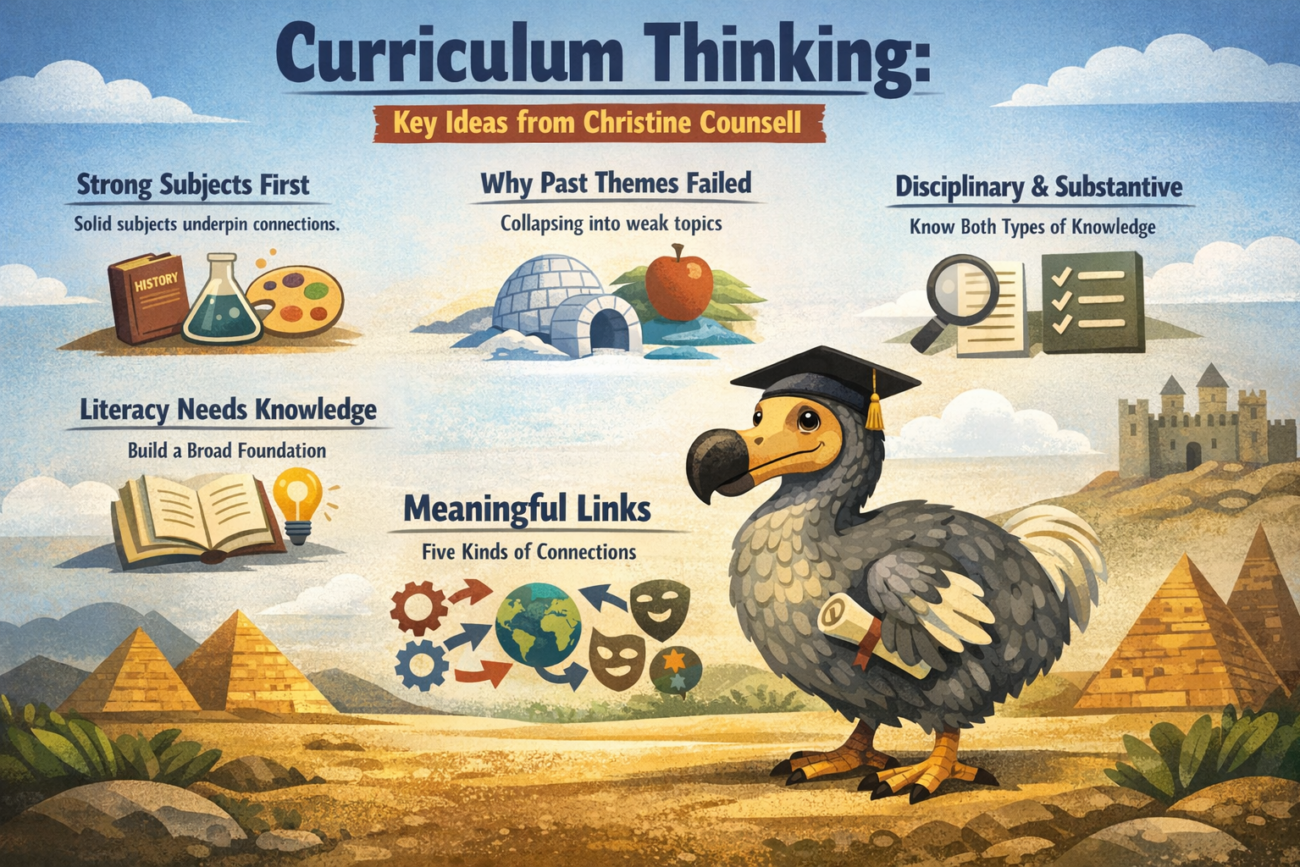
She gives examples such as “the Antarctic for a day” or “orchards” as whole‑school themes that led to “an awful lot of messing about with ice” rather than meaningful learning.
These projects ignored subject structures and produced shallow tasks.
5. The substantive vs disciplinary distinction is essential
Counsell defines two kinds of knowledge:
- Substantive: “the knowledge that is given” (facts, concepts, stories)
- Disciplinary: “how claims get tested… how the discipline is renewed”
This distinction helps teachers understand both what to teach and how subjects work.
6. Disciplines are distinct pursuits of truth
She emphasises that each subject has its own standards for valid claims:
“Scientists pursue truth through the empirical method… historians through argumentation… artists through beauty.”
Understanding these differences prevents false “generic skills” approaches.
7. Coherence over time and space gives subjects their power
Using history and art examples (Egypt → Greece), she shows how knowledge builds meaningfully when sequenced:
“The coherence of the whole subject makes new learning possible.”
This is why random topic webs (e.g., “colour → Black Death”) fail.
8. A broad, well‑sequenced curriculum massively strengthens literacy
She demonstrates how reading comprehension depends on prior knowledge from multiple subjects:
The SATs “Way of the Dodo” text required geography, science, history, and RE knowledge “that should have been really easy… had they done a properly structured curriculum.”
Literacy is not a standalone skill.
9. Subjects can support each other through five meaningful types of connection
Counsell proposes a powerful framework for cross‑subject relationships:
- High dependence (e.g., maths → science)
- Accelerated access (e.g., RE knowledge → interpreting literature)
- Simultaneous enrichment (e.g., shared texts across English & geography)
- Epistemological contrasts (comparing how subjects use terms like “evidence”)
- Integrated projects (authentic, real‑world tasks built on strong subject foundations)
10. Cross‑curricularity works best when driven by subject expertise and teacher intellectual life
She warns against SLT‑imposed thematic projects and instead champions teacher‑led connections:
“Let subjects be subjects… the best connections often come from the subject department.”
Cross‑curricularity should emerge from deep disciplinary knowledge, not managerial design.
Find out more!
You can watch the full recording of Christine Counsell here! Nobody can watch it without being converted to her way of thinking. It’s impossible!
