
1. Curriculum: what are we really talking about?
The series begins by slowing the conversation down. “Curriculum” is one of those words that everyone uses, but not everyone uses in the same way. If we don’t sort that out, everything else—knowledge‑rich, progression, coherence—floats on confusion.
A thin view of curriculum treats it as paperwork: schemes of work, long‑term plans, exam specifications, coverage maps. In that view, curriculum is essentially a compliance exercise: have we ticked off the right boxes?
A thicker view sees curriculum as the totality of what pupils encounter intellectually in a school: the ideas, stories, concepts, practices, and experiences that shape their understanding of the world. It’s not just what’s written down; it’s what is actually taught, revisited, and remembered.
From that richer perspective, curriculum has at least four dimensions:
- Content: the specific knowledge, concepts, texts, and experiences pupils meet.
- Structure: how that content is organised over time—within subjects, across key stages, and across the whole school.
- Intention: the underlying view of what is worth knowing and why; the values and purposes that drive selection.
- Experience: how pupils actually encounter that content in lessons, tasks, and assessments.
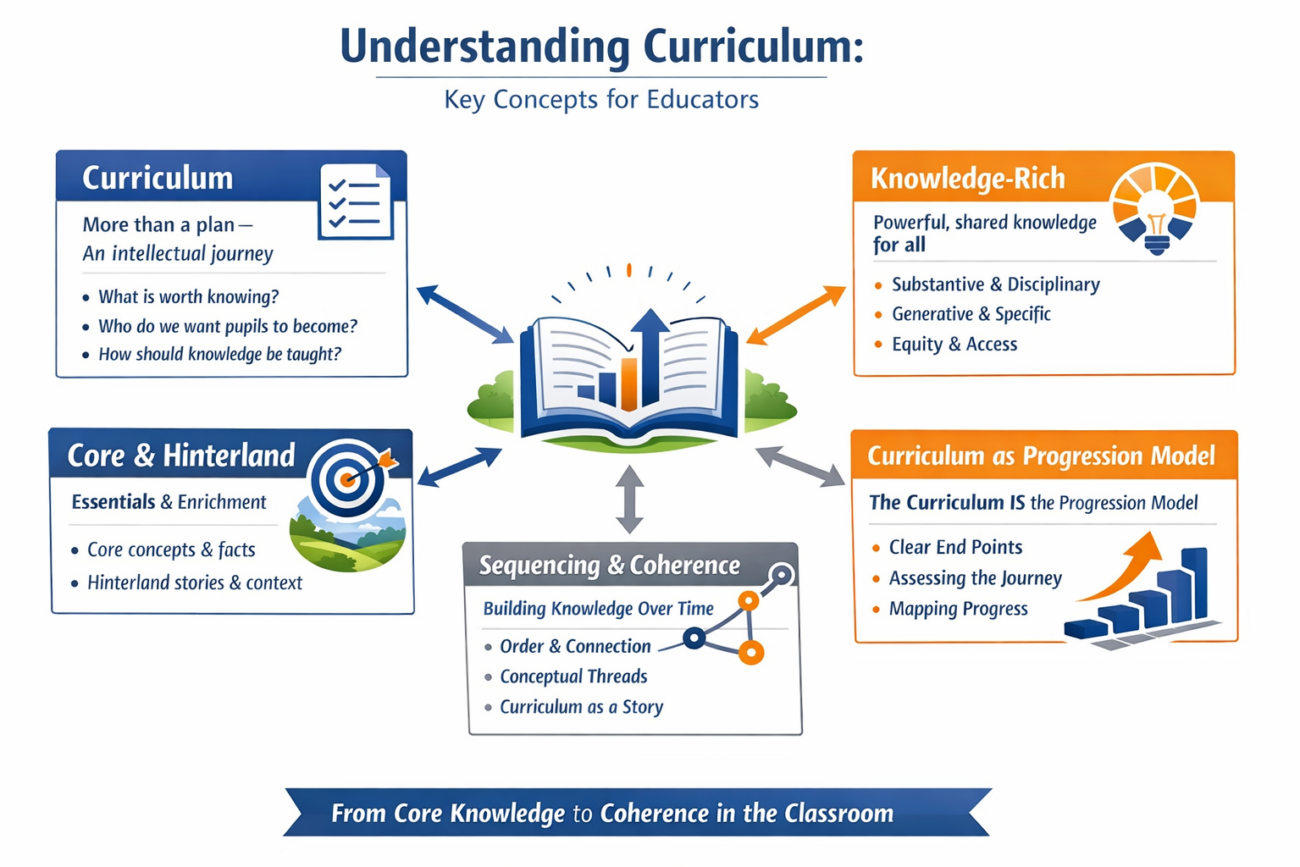
The first post’s key move is to insist that curriculum is a set of choices—moral, cultural, disciplinary, and practical. When we argue about curriculum, we’re really arguing about:
- What we think is worth knowing.
- What kind of person we want our pupils to become.
- How we believe knowledge is best organised and taught.
Everything else in the series flows from that starting point: curriculum as a deliberate, principled intellectual journey, not just a list of topics.
2. Knowledge‑rich: what are we really talking about?
Once curriculum is framed as a deliberate journey, the next question is: what should that journey be rich in? The second post tackles the now‑ubiquitous phrase “knowledge‑rich”.
“Knowledge‑rich” is often caricatured. It’s not:
- A random heap of facts.
- A joyless trudge through a textbook.
- A rejection of skills, creativity, or discussion.
Instead, the argument runs along four lines.
2.1 Knowledge is generative
The more you know, the more you can understand, think with, and create. Background knowledge isn’t a bolt‑on; it’s the medium in which thinking happens. Without sufficient prior knowledge, pupils struggle to comprehend texts, solve problems, or engage in higher‑order tasks—not because they lack “skills”, but because they lack the conceptual and factual substrate those skills operate on.
2.2 Knowledge is specific, not vague
We don’t teach “critical thinking” in the abstract. We teach pupils to think critically about something: a historical interpretation, a scientific claim, a piece of writing, a data set. Similarly, “resilience” or “creativity” are not free‑floating skills; they are developed through engagement with particular content and challenges.
A knowledge‑rich curriculum is therefore concrete: it names the actual stories, concepts, texts, events, and procedures pupils will encounter.
2.3 Knowledge is structured in disciplines
Knowledge isn’t just a pile; it’s organised into disciplines—history, science, geography, mathematics, literature, art—each with its own ways of building, testing, and organising knowledge. A knowledge‑rich curriculum respects those structures rather than flattening everything into generic “topics” or “skills”.
2.4 Knowledge is for everyone
Perhaps the most important claim: a knowledge‑rich curriculum is an equity move. Powerful cultural and disciplinary knowledge should not be reserved for those who happen to pick it up at home. Schools commit to teaching it explicitly, systematically, and to all pupils.
So when the blog talks about “knowledge‑rich”, it really means: carefully chosen, well‑sequenced, shared disciplinary knowledge that we commit to teaching every child. It’s not about stuffing heads; it’s about giving pupils the conceptual tools to make sense of the world.
3. Disciplinary and substantive knowledge: what are we really talking about?
The third post zooms in further, distinguishing between substantive and disciplinary knowledge—terms that have become central in curriculum thinking.
3.1 Substantive knowledge: the “stuff” of the subject
Substantive knowledge is the content of a subject:
- In history: events, people, periods, concepts like “empire”, “revolution”, “parliament”.
- In science: laws, theories, models, definitions.
- In geography: places, processes, patterns, concepts like “erosion” or “globalisation”.
- In English: texts, genres, literary concepts.
It’s what pupils can often state, recall, or recognise: the “what” of the subject.
3.2 Disciplinary knowledge: how the subject works
Disciplinary knowledge is about how knowledge is generated, tested, and argued about in that subject:
- In history: using sources, weighing interpretations, understanding causation and significance.
- In science: hypothesising, experimenting, analysing data, revising models.
- In geography: using maps, data, fieldwork, and spatial reasoning.
- In English: analysing texts, constructing interpretations, understanding authorial choices.
It’s the “how we know” and “how we do” of the subject.
3.3 Why the distinction matters
The blog’s key point is that a serious curriculum must attend to both:
- If we only list substantive knowledge, we risk turning subjects into inert fact‑banks.
- If we only focus on disciplinary “skills” without substantive content, we end up with pseudo‑disciplinary tasks that lack intellectual substance.
Real disciplinary thinking requires something substantive to think about, and substantive knowledge is better understood when pupils see how it was constructed.
For curriculum design, this means:
- Being explicit about which disciplinary ideas pupils will meet at different stages (e.g. “interpretation” in history, “modelling” in science).
- Designing tasks that genuinely rehearse disciplinary thinking (e.g. weighing competing historical interpretations, evaluating scientific evidence), not just dressing up generic activities in disciplinary language.
- Avoiding activities that mimic the surface features of a discipline without its underlying logic (e.g. “pretend you are a Roman soldier” as “history”).
This distinction becomes crucial later when we talk about progression: pupils don’t just progress by knowing more “stuff”; they also progress by thinking more like a novice‑to‑expert member of the discipline.
4. Sequencing and coherence: what are we really talking about?
Once we’ve decided what knowledge matters—substantive and disciplinary—the next question is: in what order should pupils encounter it, and how do we make it hang together? That’s the focus of the fourth post: sequencing and coherence.
4.1 Sequencing: the order of encounters
Sequencing is about the order in which knowledge is introduced, revisited, and deepened. Good sequencing:
- Moves from foundational to more complex ideas.
- Ensures new learning rests on secure prior knowledge.
- Builds in planned revisiting so that important ideas are strengthened over time.
Examples:
- In history, pupils might first meet a simple narrative of the Norman Conquest, then later revisit it through lenses of causation, significance, and interpretation.
- In science, they might begin with concrete phenomena (e.g. observing changes of state) before moving to more abstract particle models and equations.
- In maths, they might secure number sense and place value before moving into algebraic generalisation.
The blog’s argument is that sequencing is not just “what comes next on the scheme”; it’s a theory of how understanding grows in that subject.
4.2 Coherence: the curriculum as a story
Coherence is about how well the curriculum hangs together as a whole. A coherent curriculum:
- Has clear through‑lines—big ideas and concepts that recur and deepen over time.
- Avoids disconnected “topic hopping” where units feel like isolated islands.
- Makes relationships between ideas explicit to pupils.
Coherence is where curriculum stops being a list and becomes a narrative: a story of how pupils’ understanding will develop from novice to more expert.
Practically, this means:
- Identifying key concepts that spiral through the curriculum (e.g. “civilisation”, “energy”, “representation”, “proof”).
- Checking that each unit earns its place by contributing to those through‑lines.
- Designing assessment and tasks that reflect the structure of the curriculum, not just the last few lessons.
The post is pushing against a “coverage” mindset and towards a conceptual architecture: curriculum as a carefully built structure, not a scrapbook.
5. Core and hinterland: what are we really talking about?
The fifth post introduces a powerful distinction: core and hinterland.
- The core is the essential knowledge pupils must secure: the key concepts, texts, facts, and procedures without which they cannot progress.
- The hinterland is the rich surrounding material that gives depth, colour, and meaning: stories, examples, anecdotes, wider reading, cultural references, additional texts.
The temptation is to see these as rivals—either we focus on the core (and risk being “dry”) or we indulge in hinterland (and risk losing focus). The blog argues instead that they are mutually reinforcing:
- The core gives structure, clarity, and focus.
- The hinterland gives texture, motivation, and memorability.
Examples:
- In English, the core might be a set of key texts and concepts (e.g. a Shakespeare play, rhetorical devices, narrative structure). The hinterland might be additional poems, contextual material, related texts, and critical perspectives that deepen understanding and engagement.
- In history, the core might be the key events and concepts in a period; the hinterland might be personal stories, artefacts, local case studies, or wider reading that bring that period to life.
- In science, the core might be key laws, models, and procedures; the hinterland might be historical case studies of scientific discovery, contemporary applications, or ethical debates.
For planning, this distinction is incredibly useful:
- It forces us to name the core: what must every pupil know and be able to do?
- It legitimises richness: we can consciously curate hinterland without feeling guilty, because we know what we’re protecting at the centre.
- It clarifies assessment: we assess the core, while recognising that hinterland supports understanding and motivation.
The post also hints at something more subtle: teachers themselves carry a personal hinterland—what they’ve read, seen, thought about. A strong curriculum gives them a clear core, but also space to draw on their own hinterland to enrich it.
6. Curriculum as the progression model: what are we really talking about?
The final post in the series tackles a big idea that has become increasingly influential: the curriculum itself is the progression model.
Historically, schools often treated “progress” as something separate from curriculum: levels, sub‑levels, flight paths, generic descriptors. The blog argues that this is backwards. Progress is not a number; it is pupils knowing more and remembering more of the curriculum we have deliberately set out for them.
6.1 Progress as movement through the curriculum
In this view:
- Progress is increased security and sophistication in specific knowledge and skills—substantive and disciplinary.
- The curriculum defines what it means to get better in a subject.
- Assessment’s job is to check how far pupils have travelled through that curriculum, not to invent a separate “progression system”.
This has several implications.
6.2 Clarity about endpoints
You need to know what you want pupils to know and be able to do at key points:
- End of a unit.
- End of a year.
- End of a key stage.
Those endpoints are not generic (“be more independent”) but curriculum‑anchored (“can explain X using concept Y; can apply procedure Z; can evaluate interpretation A using criteria B”).
6.3 Mapping the journey
Once endpoints are clear, you map backwards:
- What prior knowledge and experiences are needed?
- How will key concepts be introduced, revisited, and deepened?
- Where will disciplinary ideas be first encountered and then developed?
This is where all the earlier posts come together: knowledge‑rich content, disciplinary/substantive distinctions, sequencing, coherence, core/hinterland.
6.4 Assessment aligned to curriculum
If the curriculum is the progression model, assessment must sample the curriculum, not some abstract notion of “ability”. That means:
- Designing questions and tasks that directly probe the core knowledge and disciplinary thinking you’ve planned.
- Using assessment information to see where in the curriculum pupils are secure or insecure, rather than labelling them generically.
When we say a pupil is “behind” or “ahead”, we mean in relation to the curriculum map, not in relation to a norm‑referenced level system.
The post’s underlying challenge is clear: you can’t bolt on a progression model after the fact. A well‑designed curriculum is the progression model. Our job is to make that curriculum clear, coherent, and teachable.
7. Pulling the series together: a coherent curriculum picture
Seen as a whole, the six posts form a joined‑up argument about serious curriculum thinking:
- Curriculum is not just paperwork; it is the intellectual journey we design for pupils.
- That journey should be knowledge‑rich, grounded in powerful, shared disciplinary knowledge.
- To design it well, we must understand substantive and disciplinary knowledge, and plan for both.
- We must then sequence that knowledge carefully and build coherence over time.
- We should distinguish between core (essential) and hinterland (enriching), valuing both but protecting the core.
- Finally, we should see the curriculum itself as the progression model—progress is pupils moving securely through that carefully designed journey.
Underneath all of this is a particular view of teacher professionalism:
- Teachers and leaders are not just deliverers of schemes; they are curriculum thinkers.
- Curriculum work is not a one‑off project; it is ongoing intellectual labour.
- The aim is not to chase slogans, but to build something coherent, principled, and sustainable.
If this summary was interesting, check out Joshua Vallance’s full set of articles.
They are superb! A great curriculum thinker in full flow.
Start with the first one in the series…
